

How To Add Custom Sounds To Gmod Animations
Custom Sounds: we all love them, nosotros all try them, merely virtually of united states fail miserably. The reason? Most of the sounds in HL are looped. This ways ane curt sound that has been created and then that the stop of it will fluently run into the beginning, as with textures. A badly looped sound is just as bad as a badly tiled texture.
Previously, there has been some confusion over what format a sound must have to be accepted into the game. Even so, after much investigation and several heated arguments in forums, I can reveal that all sounds must be:
- xi or 22 kHz frequency (22 kHz is ameliorate quality)
- Recorded in WAV format, uncompressed
- 8-bit, (newer versions of HL may take 16-bit)
- Mono
- Saved with cue points (don't worry, this will be explained!)
There are two methods of obtaining a custom sound - from the Internet, or from the ambience itself, using a microphone. If yous get the sound off the Net, skip to "Creating the Cue Points".
Obtaining a sound using a microphone
What you're gonna need:
- A decent mike; I'm using a Technica ATW1452, but it depends on how good a quality a recording you desire, and how much you're willing to pay.
- A practiced Audio Editing Program. I used Cubase SX2, only programs such equally Cool Edit and Goldwave volition work, every bit long as they have the ability to create cue points (and they're gratis).
- Hammer
The biggest problem with making an ambience audio from your own habitation, for example, is getting the sound to your PC. In that location are many other methods including Dictaphones etc, but none match the quality of a professional microphone. So yous accept 4 choices:
- Use a mike cablevision extension pb
- Utilise a radio mike (probably easiest option, merely unremarkably nearly expensive)
- Bring computer to object (necessary if recording a machine engine for instance)
- Bring object to computer (possible for things such as microwaves, etc!)
Each option has both advantages and disadvantages, but in the terminate all accomplish the same event. In this instance, I am going to utilize a radio mike, but information technology's not important.
When recording your sound, brand sure you have no disturbances. The last thing you lot want is a computer buzz with your bro screaming "MUM!!!!" in the background! No, seriously, what I mean is microphones can be extremely sensitive, and then unless you are using good software with cancellation abilities, chances are you'll choice upwards something else as well.
When positioning a mike, information technology's always good to employ a stand where possible, as laying a mike on a smooth / hard surface while recording will result in unwanted vibrations being picked up. Y'all too desire to identify your microphone about two inches away from the source. This volition mean a expert choice-upwards, but no unwanted audio.
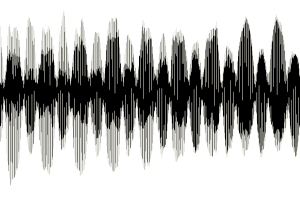
Finally, heed to your sound before recording. Why? Tremolo. All sounds accept tremolo, an audio feature that, if stiff, gives the sound a pulsing event. The stronger the tremolo, the faster the sound will pulse, giving it a natural bicycle. A weak tremolo is either unnoticeable, or will pulse very slowly. If the tremolo is noticeable in your sound, information technology is vital that yous record at least i cycle of information technology. The case map download includes a sound with stiff tremolo and i with weak tremolo then you lot know what I'k talking about! Below are two examples of weak (top) tremolo, and strong (bottom) tremolo. Yous can clearly see that stronger tremolo has much shorter waves than the weaker tremolo: about viii oscillations of the potent tremolo fit into ane cycle of the weak tremolo. The horizontal scales are equal. These sounds are provided in the example ZIP at the terminate of this tutorial for your listening pleasure.
 Weak tremolo
 Potent tremolo
Recording your sound
In one case your mike is set up, load upwards a new session in your editing program and change its attributes to those at the offset of this tutorial. THIS IS ESSENTIAL! Outset your sound 'emitter' if necessary, and so start the recording. Simply end information technology when you are sure that it has passed through at to the lowest degree 1 natural bike. Now, salvage your sound, and remember, WAV format just!
Preparing your audio for HL
Now here's the tricky function - making the sound smoothly repeatable. Although I tin guide you through this department, in the stop, it is down to homo skill and patience. It also helps having a good ear for music! I mainly only create 'single-play' custom sounds because it is so much easier to make information technology sound professional! If you've followed this tutorial so far, you should now accept a crude audio that includes i full natural bicycle. We now want to take that down to only the cycle. This will mean endless playback of the sound, which volition get rather annoying by the end, only its well worth information technology!
At present, using a cut, trim, splice, whatever tool bachelor on all skilful audio editors, you need to slowly trim abroad at your sound from both the showtime and end until y'all are nigh the natural cycle. Now, turn on bike / repeat at this point, because it's here that you need to be precise. Take 1/100 of a second off at a fourth dimension if necessary, but go that audio sounding proficient! Ok, so I assemble you lot've done that at present, preferably without smashing your figurer to pieces. And if yous have, well, don't blame me!
Creating the Cue Points
You now need to create the cue points, the last merely most vital role of creating a looping audio. A cue signal tells the game where the audio should brainstorm and where it should end. Without them information technology would either never offset, or never repeat - in other words, it's non good! In almost editors you can probably do it similarly to this:
For Absurd Edit 2000
- Click on the 'view' tab adjacent to edit, and then click on "cue list."
- Click once at the commencement of your wave and click add in the cue listing menu.
- Click one time at the stop of your wave and click add in the cue listing menu.
- Click washed, save your sound over again and and so exit the editor.
Inserting your Custom Sound into HL
At present all yous demand to do with your correctly-formatted audio file is place information technology correctly in Half-Life'due south directory construction and put information technology in your map. Pretty elementary: you can put the sounds anywhere in One-half-Life/modname/sound. Y'all can organise your files in subdirectories if you and so desire. In Hammer, you lot should specify the path to the sound in the form subdirectory/audio.wav, i.e. just foo.wav if your sound is just in audio, or bar/new/foo.wav if it's in the bar and new subdirectories. Yous may wish to check the ambient_generic entry in our HL entity guide.
Source: https://twhl.info/wiki/page/Tutorial:_Making_Custom_Sounds
Posted by: levesqueyounproyes1962.blogspot.com
0 Response to "How To Add Custom Sounds To Gmod Animations"
Post a Comment